


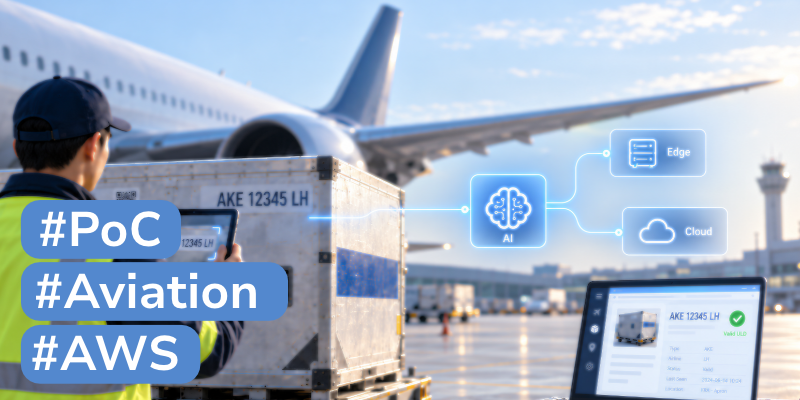
Manually transcribing ULD (Unit Load Device) numbers from photos is time-consuming and increases the risk of errors. By using artificial intelligence, this process can be automated.
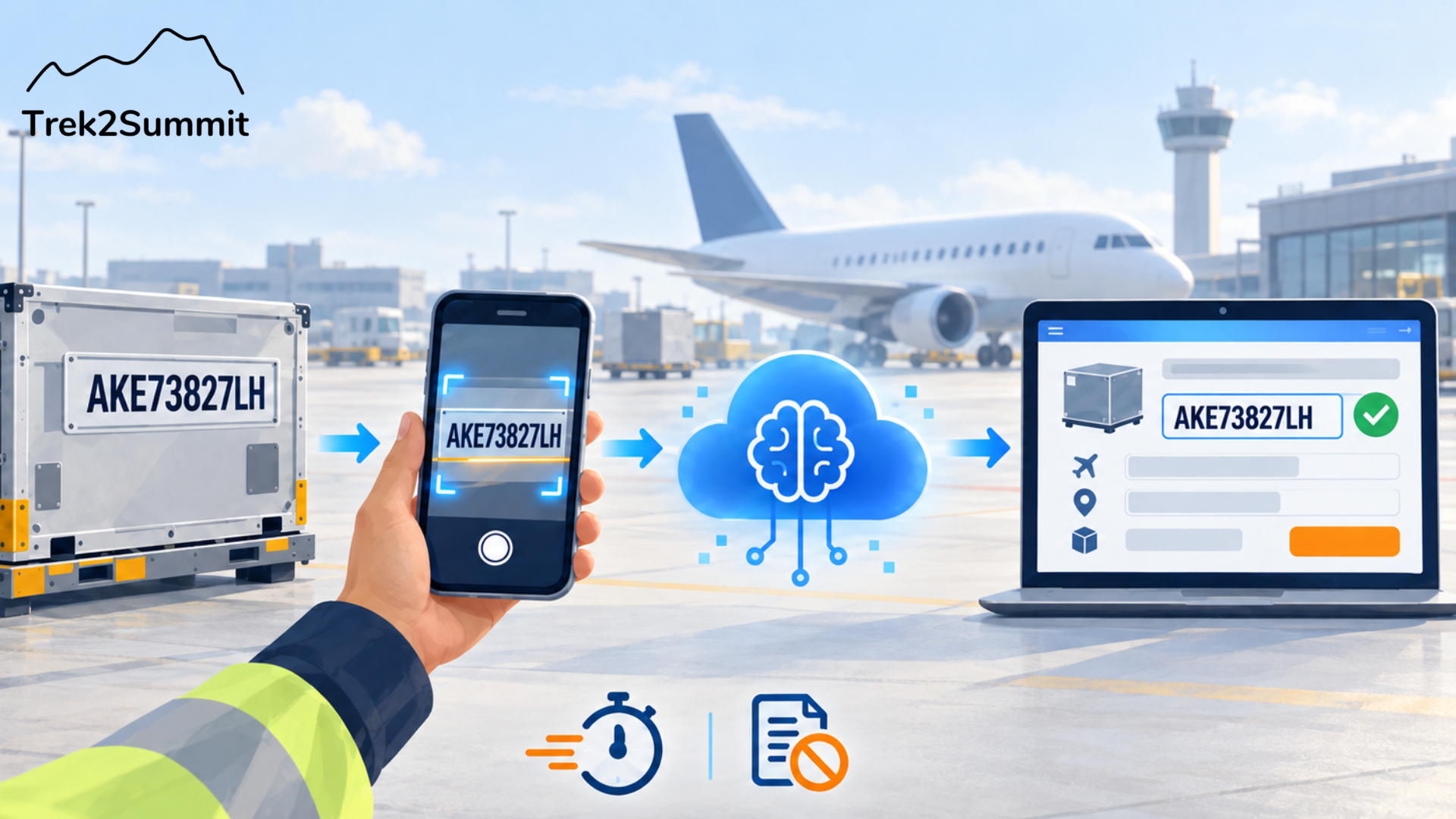
Manually entering ULD (unit load device) from photos can be replaced by a process in which the user uploads a photo of the label, and the system automatically recognizes the code needed to fill out the form.
It was precisely this scenario that was tested as part of a Proof of Concept (PoC) developed for a company in the aviation industry. The PoC made it possible to compare solutions using AWS services and OCR models running locally on the device.
The project was research- and demonstration-based. Its goal was not to deliver a ready-made production system, but to gather measurable results, identify the technology’s limitations, and determine possible directions for further development.
Challenge: Reducing Manual Data Entry
The starting point was the process of entering the ULD number into the appropriate forms. Instead of manually reading the code from a photo and transcribing it into the form, the user should be able to upload a file that will be automatically analyzed.
The PoC was designed to assess how well existing technologies handle the recognition of numbers resembling ULD codes and to identify the differences between the various approaches.
Automatic ULD Number Recognition
As part of the project, a demo browser application was developed. A logged-in user can upload a JPG or PNG image and then compare the results obtained by Amazon Rekognition and Amazon Nova 2 Lite.
The app displays the recognized text and the response time for each service. For Amazon Rekognition, a confidence score is also available, indicating the level of confidence for the matched words.
This approach made it possible to evaluate various methods of automatically recognizing ULD markings. The comparison included the recognized text, the consistency of the codes with the reference labels, and the analysis time.
A demo application using AWS
In the demo browser app, a logged-in user can upload a photo in JPG or PNG format. The user can then compare the numbers recognized by Amazon Rekognition and the Amazon Nova 2 Lite.
The app features:
- recognized text,
- the response time for each service,
- Confidence score for words matched by Amazon Rekognition.
The expected ULD number format can be configured in a Terraform variable (a tool for automatically managing a company’s entire IT infrastructure using code). The results and processing history are stored in private AWS storage, and the uploaded source images are deleted after 30 days.
The PoC includes the complete infrastructure-as-code and a deployment script designed to launch the solution in a standalone AWS environment.

OCR Tests on 108 ULD Photos
The Edge OCR models were tested on 108 photos of ULD markings.
The Paddle Small achieved the best quality score:
- 90 out of 108 photos were fully correct,
- The match rate between the recognized codes and the reference labels was 93.9%,
- The median analysis time was 0.55 seconds.
The fastest model was Paddle Tiny, with a median analysis time of 0.19 seconds. The model produced a completely correct result for 78 out of 108 images, with a code match rate of 82.4%.
Trek2Summit | AI Analysis
Comparison of the Effectiveness of AI Models
Results of automatic number recognition tests for ULD air cargo containers based on 108 images. Comparison of reading accuracy and median processing time.
| Model | Photos that are completely correct | Code Compatibility | Median time |
|---|---|---|---|
|
Small Paddle
Highest compatibility
|
90/108 |
93,9%
|
0,55 s |
|
Tiny Paddle
|
78/108 |
82,4%
|
0,19 s |
|
Florence
|
64/108 |
68,8%
|
1,38 s |
|
SmolVLM
|
14/108 |
58,6%
|
0,83 s |
All four models completed the tests without any engine errors. The tests were conducted locally in Chrome on an Apple MacBook Pro with an M1 processor. Because the models run offline, the times obtained may vary depending on the device.
The Value of PoC for the Aviation Industry?
The PoC provided the customer with a concrete benchmark for evaluating ULD automatic number recognition technology.
The project made it possible to:
- a comparison of cloud-based and on-premises approaches,
- testing the models on a real dataset of 108 photos,
- a comparison of recognition quality versus analysis time,
- identifying differences between the models being tested,
- preparing the environment for further evaluation of the technology.
The most important outcome of a PoC is not a declaration of production readiness, but rather the collection of data needed to assess which approach is worth pursuing further.
The Results of the Expert Assessment in Practice
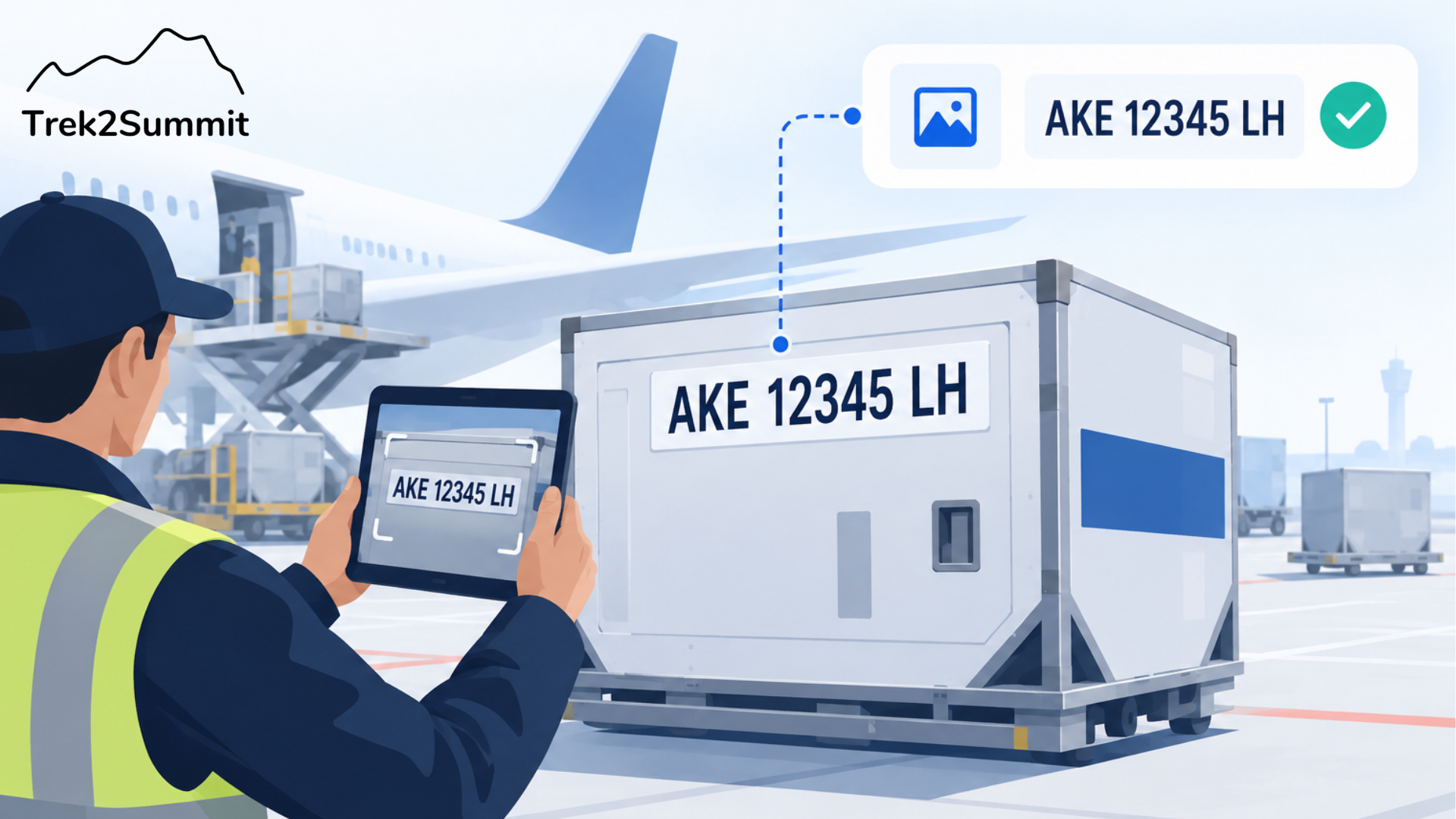
The project focuses on a specific process characteristic of the aviation industry. Automatic ULD recognition requires working with markings used in the aviation environment and evaluating the quality of the readings based on actual images.
The PoC compared several technologies and models. The results show differences in both code recognition quality and analysis time. This data makes it possible to assess which approaches are worth considering for the solution’s further development.
The Paddle Small achieved the best result in the tested configuration, while the Paddle Tiny delivered the lowest median analysis time.
Summary
A PoC developed for the client demonstrated how various OCR technologies perform in the automatic recognition of ULD numbers. Trek2Summit compared an approach using AWS services with on-premises models, laying the groundwork for further evaluation of the solution’s quality, speed, and architecture.
Paddle Small achieved the best quality results in the Edge OCR tests, with 93.9% code accuracy and 90 fully correct results out of 108 images. At the same time, the tests confirmed that further work and a more thorough evaluation of difficult cases are needed before any potential production deployment.